The Naked Marriage: Uncovering Who You Are
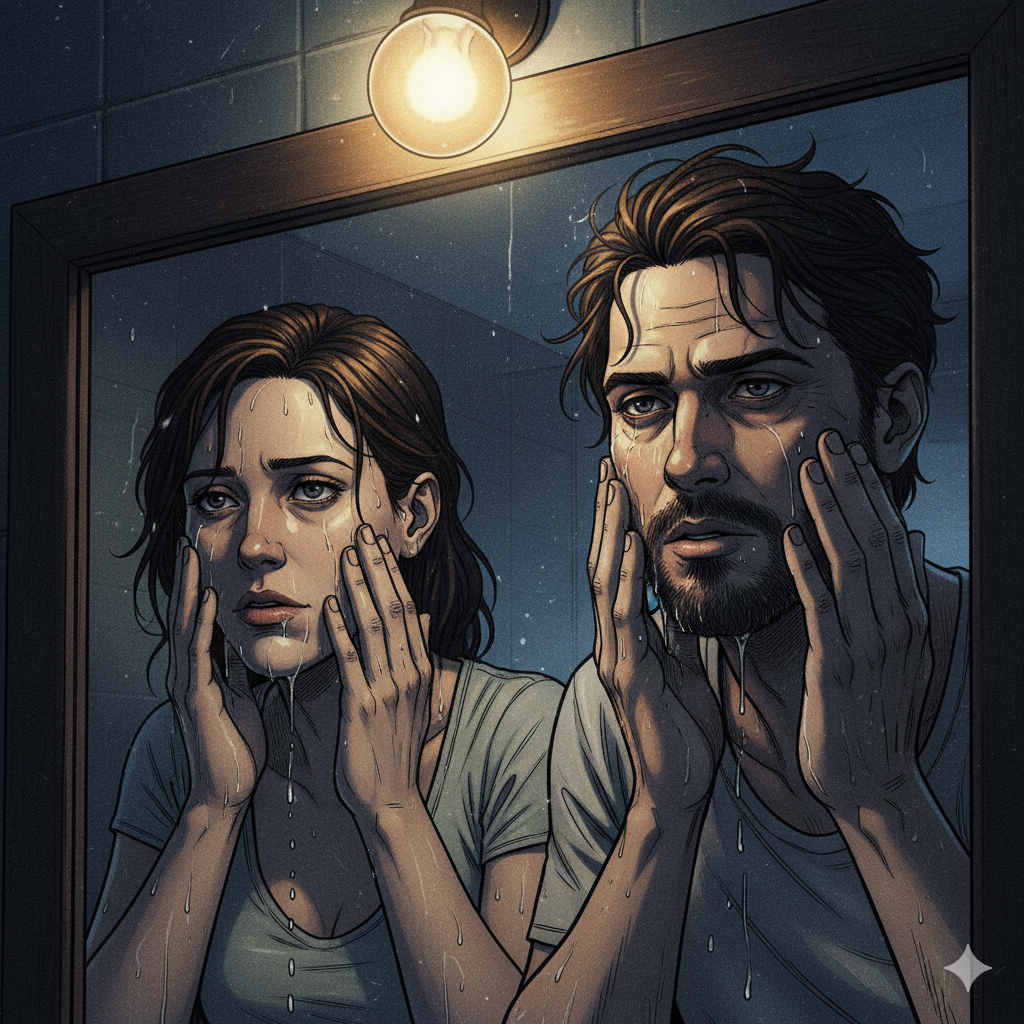
You lock the bathroom door, turn on the tap, and stare at your reflection
in the mirror. For the first time in ten hours, you drop the smile. You
let your shoulders slump. You exhale the breath you’ve been holding since
you woke up next to the person you promised to love forever.
It’s exhausting, isn’t it?
Not the marriage itself. Not the logistics of bills, kids, or deciding
what to eat for dinner. It’s the performance. The subtle, draining act of
pretending to be the “good spouse,” the “stable partner,” the one who has
it all together. You are married, but you are hiding. You are sharing a
bed, but you are emotionally clothed in layers of armor, defense
mechanisms, and carefully curated half-truths.
Let’s talk about stripping that away.
The Myth of the “Perfect Match”
We are sold a lie from the moment we start dating. We are told that
marriage is about finding someone who “completes” us. So, we present a
version of ourselves that is complete-able. We polish our edges. We hide
our neuroticism. We pretend we love hiking when we actually prefer
sleeping in. We pretend we are financially savvy when we are actually
terrified of money.
Then we get married, and the panic sets in. Because now, you have to
maintain that avatar 24/7. You can’t.
Most couples drift apart not because they stop loving each other, but
because they get tired of acting. They retreat into their phones, their
jobs, or their hobbies because those are the only places where they don’t
have to pretend. This is the “Roommate Syndrome.” It’s safe. It’s polite.
And it is the slow, silent killer of intimacy.
🧠 The Psychology of “Covering”
Why do we do this? Why do we hide from the one person who is supposed to
know us best?
It’s called “Attachment Shame.”
Deep down, your inner child believes that if you show your true self—the
needy, angry, fearful, chaotic version—you will be rejected.
Evolutionarily, rejection meant death. So, you create a “False Self” to
secure attachment. You become the “Low Maintenance Wife” or the “Stoic
Provider Husband.” You trade authenticity for security. But the cost is
high:
You cannot feel loved for who you are if you never show who you
are.
You only feel loved for the performance.
What a “Naked Marriage” Actually Looks Like
Get your mind out of the gutter for a second. While physical intimacy is a
massive part of this, a truly “Naked Marriage” is about psychological
nudity. It is the terrified, shaking-hand decision to drop the towel and
let your partner see the scars, the cellulite of your soul, and the ugly
parts of your history.
It means saying things that feel dangerous.
It means admitting:
“I’m not just tired. I’m bored of our routine.”
It means confessing:
“I feel weak when I can’t provide the way I want to.”
It means stopping the politeness. Politeness is for strangers. Marriage
requires raw, unfiltered reality. If you are constantly polite to your
spouse, you are distancing yourself from them.
📝 Case Study: The 2 A.M. Kitchen Confession
David and Elena had been married for eight years. To their friends, they
were the power couple. But at home, the silence was deafening. David
would retreat to his study; Elena would obsess over the kids.
One Tuesday at 2 a.m., David found Elena in the kitchen, eating
leftovers in the dark. Usually, he would have just grabbed water and
went back to bed.
Instead, he sat down. He didn’t ask, “Are you okay?” (The polite lie).
He said,
“I feel like I’m invisible in my own house, and I think you hate
me.”
It was a grenade. It was ugly. It was naked.
Elena didn’t comfort him immediately. She got angry. She cried. She
admitted she felt lonely because he was emotionally checked out. They
fought until 4 a.m. It wasn’t pretty. There was snot, raised voices, and
harsh truths. But for the first time in five years, they were actually
looking at each other. They stopped interacting with the
“Representative” and started fighting with the human.
That fight saved their marriage. They stopped being polite roommates and
became partners in the mess.
The Three Layers of Stripping Down
If you want to stop feeling lonely in your relationship, you have to start
peeling back the layers. This isn’t easy. It feels like walking onto a
stage without your script. But here is the map.
1. Financial Nudity
Money is rarely about math; it’s about control, safety, and worth. Hiding
purchases is lying. Keeping secret accounts “just in case” is planning for
failure. A naked marriage puts it all on the table. The debt you’re
ashamed of. The anxiety you feel when the bill comes. You can’t build a
shared life if you are running separate economies of truth.
2. Emotional Nudity (The Hardest Part)
This is where you admit your needs that feel “pathetic.”
- For many men: This means admitting you are scared of
failing. We are taught that weakness is repulsive. But vulnerability is
the only thing that invites genuine connection. Your wife cannot support
you if she thinks you are a stone wall. - For many women: This often means dropping the “I’m
fine” mask. It means asking for what you want directly, rather than
hoping he will read your mind and then resenting him when he doesn’t.
3. Sexual Nudity
Beyond the act itself, this is about speaking your desires without shame.
It’s about admitting what isn’t working. It’s about removing the
performance of “good sex” to find connected sex. If you are
faking enjoyment to protect their ego, you are building a wall with every
lie.
responsible for your happiness. They are responsible for your
safety. Happiness is a byproduct of a safe environment where two
people can be completely honest without fear of abandonment.”
How to Start (Without Blowing Up Your Life)
You don’t have to dump twenty years of trauma on your spouse tonight over
lasagna. That’s not vulnerability; that’s an emotional ambush. Start
small.
The “10% More Real” Rule.
Tomorrow, be 10% more honest than you usually are. If you’re annoyed, say,
“I’m feeling irritable right now, and it’s not your fault, but I need
space.” If you’re sad, say, “I’m having a hard day.” Stop filtering the
small stuff.
When your partner tells you something hard—when they finally drop their
towel—do not try to fix it. Do not judge it. Do not make it about you.
Just look at them and say, “Thank you for telling me.”
Create a space where the truth is rewarded, not punished.
The Final Verdict
A naked marriage is dangerous. It risks rejection. It risks conflict. It
risks the comfort of the status quo. But the alternative is a slow fade
into gray—two strangers living in the same house, polite, functioning, and
utterly alone.
Stop polishing the exterior. Stop curating the Instagram captions. Look at
the person across from you and decide: Do you want a fan, or do you want a
partner?
Drop the act. It’s heavy, and you’ve been carrying it long enough.



Leave a Reply