Why People Say Sorry When It’s Not Their Fault
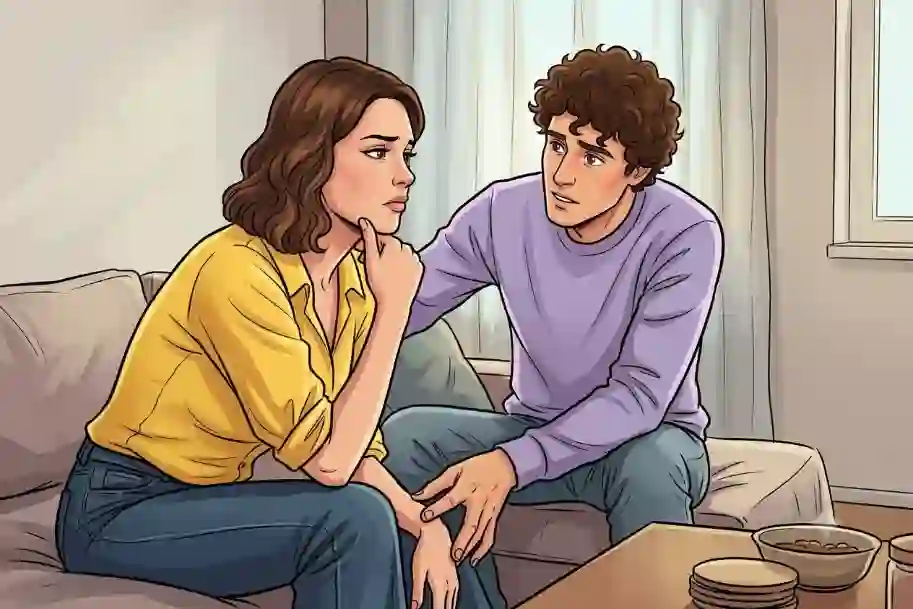
- Why people say sorry when it’s not their fault: the fear underneath
- What the word is standing in for
- Where the habit usually gets learned
- What constant apologizing quietly costs
- When the sorry is really about someone else’s reaction
- Telling a real apology from a reflex
- If your partner or friend is the one who always apologizes
- Letting the reflex loosen
- Frequently Asked Questions
Why People Say Sorry When It’s Not Their Fault
Someone bumps into Dev’s shoulder on a crowded train platform, and Dev says “sorry” before the stranger has even turned around.
Why people say sorry when it’s not their fault comes down to protection more than guilt. The word works as a quick signal that says “I’m harmless, please don’t be upset with me.” It calms tension before it can grow, and for many people that reflex was learned long before adulthood.

Why people say sorry when it’s not their fault: the fear underneath
Tension in a room registers in the body as a small threat. A tight voice, a sigh, a pause that runs a second too long: some people pick these up instantly and feel an urgent need to make them stop. An apology is the fastest tool available. It costs one word, it usually works, and the relief that follows teaches the brain to reach for it again next time.
That is how a habit forms. Nobody decides to over-apologize. The sorry gets rewarded with a softer face or a loosened shoulder, and the pattern sets.
Where does the urgency come from? Attachment theory, which grew out of John Bowlby’s work, suggests that early in life we form expectations about whether the people we depend on will stay warm. A child who learned that warmth could vanish after a frown often grows into an adult who scans every face for frowns. People-pleasing means managing other people’s moods so that your own place with them feels safe, and the apology is simply its most portable tool.
What the word is standing in for
Half the time, “sorry” is not an apology at all. It is a placeholder, and the real sentence is hiding behind it. A person who says it to a chair they just walked into has not confessed to furniture abuse. The word is doing the job of a reflex.
Here are some of the messages that often travel underneath it:
- “Excuse me, I need to get past you.”
- “Thank you for waiting.”
- “Please don’t be annoyed with me.”
- “I know I’m taking up your time.”
- “This feels awkward and I want it to be over.”
Most of these are ordinary politeness, and in some families and workplaces, apologizing first is simply how people say hello. The trouble starts with the third and fifth items, where the sorry is paying for a feeling in the room rather than for anything you did. Those are the apologies that pile up, and the ones worth catching.
Where the habit usually gets learned
Ask someone who apologizes constantly when it started, and the answer is rarely a single event. Often it is a long stretch of small ones. A kid in a home where one adult’s mood decided the evening learns to be the smoothest person in the room. A new hire with a sharp-tongued manager learns that “sorry for the confusion” ends a conversation faster than “I think the instructions were unclear.” A first partner who sulked for days over small things teaches that peace has a price, and the price is a sentence starting with sorry.
Nothing about this makes the person weak. It makes them good at reading rooms, a real skill that was trained under pressure. The problem is that the skill never got an off switch, so it runs the same way whether the person across from you is a volatile boss or a stranger on a train platform.
Some people also just grew up polite, in homes where apologizing was good manners, and carry no pain behind it at all. Not every sorry has a story.
What constant apologizing quietly costs
The first cost is that the word wears thin.
An apology works like currency: print too much of it and each one buys less.
When someone who says sorry forty times a week finally apologizes for something that matters, it lands as one more sorry in the pile.
The second cost is slower. When you take blame for things that were not yours, the people around you adjust without meaning to. A coworker stops double-checking their own work because you always absorb the mistake. A partner stops noticing they ran late because you were the one apologizing to the restaurant. Nobody is plotting this. People follow the path of least resistance, and you have been laying it down.
The third cost is the quietest. Say “my fault” often enough and part of you starts to believe it. People who over-apologize tend to feel like the difficult one, the burden, the person who is always slightly in the way, and that belief was manufactured by the habit rather than discovered through evidence.
When the sorry is really about someone else’s reaction
There is a version of this habit that deserves a more careful look. If you apologize mainly because the other person goes cold, raises their voice, or punishes you with silence when you don’t, the sorry stops being a personal quirk and becomes a response to something the other person is helping maintain.
A useful test is to notice what happens when you hold back an apology you don’t owe. If the result is a mild, awkward pause, you are dealing with a habit. If the result is days of tension, an escalation, or a rewrite of events that leaves you as the guilty party, that deserves attention in its own right. Talk it through with a friend you trust who can see the relationship from the outside, or with a counselor who works with relationship patterns. A second set of eyes is a reasonable thing to want here, and it is often the moment the pattern first becomes visible.
Telling a real apology from a reflex
Before the word leaves your mouth there is a gap of about two seconds, and it is enough for two quiet questions. Did something I did affect this person? And am I sorry about that, or sorry about how tense this feels?
If the first answer is yes, apologize cleanly and specifically: “I’m sorry I forgot to text back. That was thoughtless.” If the answer is no, you are looking at a reflex, and you can let the moment stay slightly uncomfortable. It passes faster than expected, and nothing terrible happens while it does.
Plenty of situations land in the middle, where you added one small piece to a larger mess. Those call for a partial apology: “I’m sorry I snapped. I still think the plan changed too late.” You own your piece without signing over the rest.
The easiest swap when the sorry is pure reflex is gratitude. “Thanks for waiting” keeps the warmth of “sorry I’m late” without confessing to anything. A few more that sound natural:
- Instead of “Sorry to bother you,” try “Do you have a minute?”
- Instead of “Sorry for the mess,” try “Come in, ignore the chaos.”
- Instead of “Sorry, I talk too much,” try “Thanks for listening to all that.”
- Instead of “Sorry you feel that way,” try “I can see this upset you. Tell me what happened.”
- Instead of “Sorry, my bad” when someone else bumped into you, try saying nothing, or a plain “No worries.”
Each one keeps the kindness and drops the blame, which is usually what the sorry was reaching for in the first place.
If your partner or friend is the one who always apologizes
Telling a chronic apologizer to “stop saying sorry” tends to backfire, because it hands them something new to apologize for. What helps more is making the sorry unnecessary.
“Sorry, I took forever picking a place.”
“You didn’t take long. And even if you had, I’d still be glad to be here.”
Notice what that reply does. It corrects the facts gently, and it shows that a delay does not cost them your goodwill. The second part is the real message. People who over-apologize are often testing, without knowing it, whether closeness survives an imperfect moment. Each time it does, the reflex loosens a little.
Watch your own side, too. If your face tightens when a plan changes, they will see it before you do. Calm spreads between people in the same way tension does.
Letting the reflex loosen
For one week, change nothing. Just count the sorries, in your head or in a note on your phone. Most people are startled by the number, and the startle does half the work, because a habit you can see is already a habit you can interrupt.
After that, pick one situation where an apology feels automatic, like asking a question at work or arriving a few minutes behind in a casual plan, and try one of the swaps. Expect a small wobble in your chest when the pause arrives. That wobble is the old alarm going off for a threat that is no longer there.
Once you see why people say sorry when it’s not their fault, the habit looks less like a flaw and more like old protection that never got retired. Retiring it takes practice, and the real apologies you keep will sound clearer for it.
Frequently Asked Questions
Is saying sorry too much a sign of low self-esteem? Sometimes, but not always. For some people it is just a politeness habit picked up at home or work. For others it comes from a belief that their needs cost other people something. A lingering sense of being at fault after apologizing suggests something deeper worth talking through.
Why do I apologize even when I’m the one who is angry? Anger and fear often arrive together. You may be upset and still feel the old alarm about the other person’s displeasure, so the sorry slips out to protect the connection. Try saying what you feel first, then see whether an apology is actually owed. Often the anger needed a sentence, not an apology.
Will people think I’m cold if I apologize less? Rarely. Most people notice warmth through tone, eye contact and follow-through, not through a count of sorries. If anything, your real apologies will carry more weight once the reflex ones thin out. Swapping in thanks and plain kindness keeps the warmth in place while the blame drops away.