How to know if he still loves you after a fight
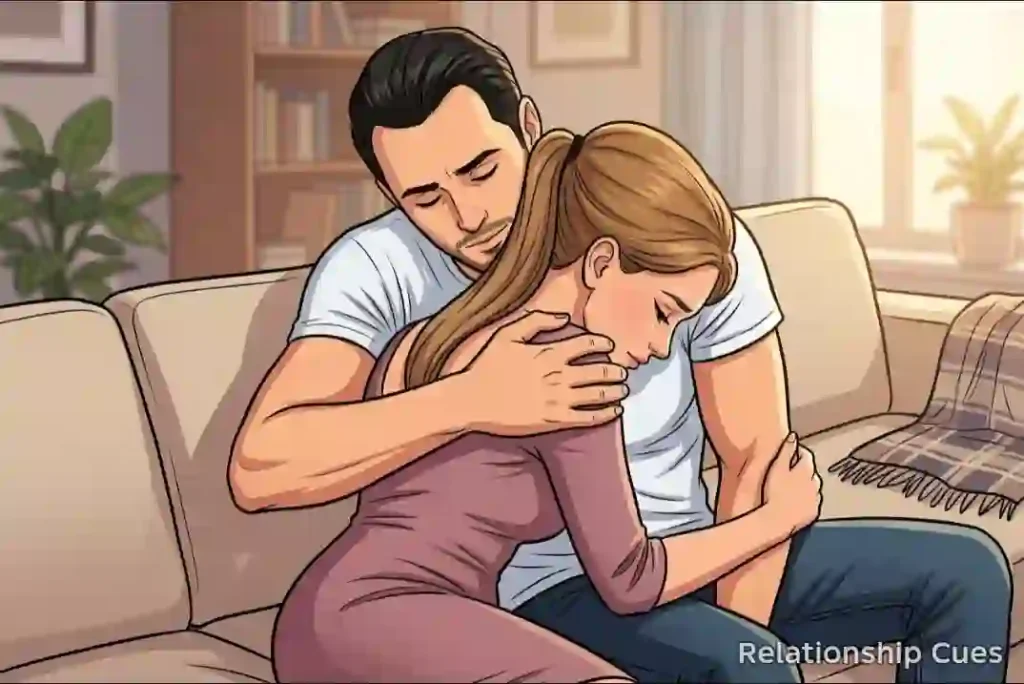
- Why the silence after an argument is so hard to read
- Signs he still loves you in the first few hours
- What repair sounds like the next day
- A week later is where the proof lives
- Warmth that repairs versus warmth that relieves
- Ask plainly, then watch what he does
- Questions people ask after an argument
- How long should a man need to cool down after a fight?
- Can he still love me if he goes silent for days after every fight?
- Does it mean he doesn’t love me if he won’t apologize?
Signs He Still Loves You After a Fight and What to Do
Two hours after the argument, he walked past you in the hallway and turned the thermostat back to the temperature you like. Neither of you mentioned it. You noticed anyway.
The clearest signs he still loves you after a fight show up in what he does once the heat drops: he returns to ordinary kindness, stays curious about your side, and works to repair things instead of winning. Words in the moment matter less than steady effort over the following days.
Why the silence after an argument is so hard to read
In the middle of a heated argument, the body reacts before the mind catches up. The psychologist John Gottman calls this flooding: a pounding heart, narrowing thoughts and a sudden loss of the ability to listen. A flooded person often goes silent, leaves the room or answers in single words. From the outside that looks like coldness. From the inside it is usually closer to overload.
That gap is where most of the pain lives. You read his silence as a verdict on the relationship, while he may be working hard not to say something he can’t take back. Some people also go quiet out of shame about how they acted, and since they have no idea how to reopen the conversation, they wait. The waiting looks like indifference.
This is why the first few minutes tell you so little. Tone, volume and the last sentence he said at the door mostly measure how he handles stress. Love becomes readable later, once his body has calmed down, and that is the order this guide follows: hours, then a day, then a week.
Signs he still loves you in the first few hours
Right after a fight, words are unreliable and small actions are steadier. Watch for these:
- He keeps the ordinary kindnesses going, such as refilling your water, warming up the car or saving you the last of something, even while he is stiff and short on words.
- He stays within reach. He is in the next room or the same car, not out the door for hours with nothing said.
- He avoids the cruel line. Even angry, he does not use your insecurities, your family or your past as ammunition.
- He tells you he needs a break and says when he will be back.
The last one is the most useful and the easiest to miss.
A break with an end time is a pause. A break with no end time is a wall.
This is what a pause sounds like: “I’m too wound up to talk well. Give me an hour, and I’ll come find you.” A man who says that is protecting the conversation, and he plans to return to it. Compare him with someone who leaves, answers nothing and later acts as though the fight never happened. The first is cooling off. The second is closing a door, and a door closed after every fight teaches you to stop bringing things up.
If he hasn’t come back by the time he named, you can say, “It’s been three hours. Are we talking tonight or tomorrow?” Either answer is fine. A specific answer is what you are after.
What repair sounds like the next day
A repair attempt is anything one partner does to lower the tension and reconnect: an apology, a joke, a hand on your back, an offer to start over. Gottman’s work suggests that how well these attempts land says a lot about whether a couple recovers from conflict. They also arrive in odd packaging. A man who is bad with words may make you a plate of food, ask how you slept or say, “So that was a rough one.” That is an awkward but real attempt, and it deserves to be read as one.
Take two couples who argued the night before a cousin’s wedding. In the first, he says during the drive the next morning, “I’ve been thinking about what you said, that I make plans without checking with you. You were right about the last two.” He names the issue, owns a piece of it and does not demand instant forgiveness.
In the second, he is cheerful all morning and jokes with the relatives. When you raise the fight in the hotel corridor, he says, “Can we just enjoy the weekend?” He may love you just as much as the first man does. But the first man is repairing, and the second is using a good mood to close the subject, which leaves the issue waiting for you at home.
Listen to the shape of the apology too. “I’m sorry I raised my voice and brushed off what you said” has a specific piece of him in it. “Sorry you took it that way” hands the problem back to you.
A week later is where the proof lives
The most reliable signs he still loves you are the ones that outlast the first apology. A week after the fight, the heat has faded, but the evidence is sitting in his behavior if you know where to look.
- What you said shows up in small choices. He checks with you before booking the weekend, or he lowers his voice when the same topic returns.
- He asks a real question, like “What would make you feel more included?”, and then waits for the answer.
- The same fight comes back softer, shorter or with a faster repair.
- His affection no longer arrives with an agenda, meaning it is not just a way to skip the talk.
Give this a fair window. Change after conflict is slow and uneven, and one slip does not cancel a real effort. Direction matters more than perfection. A man who fumbles the old habit once and then catches himself (“Sorry, I did it again, let me ask you first”) is moving the right way.
Love after a fight is rarely a grand gesture. More often it is someone slowly turning back toward you, a little awkwardly, over several ordinary days.
Warmth that repairs versus warmth that relieves
Some behavior feels warm and does a different job. Relief has its own signs: sudden sweetness the moment you stop being upset, a gift or a plan that arrives in place of the conversation, affection that disappears if you bring the issue up again. The test is where the warmth points. Warmth that moves you toward the conversation is repair. Warmth that replaces the conversation is mostly a way to end his own discomfort.
There is an exception worth knowing, because it fools people in the other direction. Some people take a day or two to come back, especially those who tend to retreat when closeness feels like pressure. Attachment theory calls this an avoidant style. Slow is not the same as absent. What separates the two is whether he returns on his own and whether he can talk once he does.
One limit on all of this. If fights leave you afraid of him, if he threatens you, breaks things, controls where you go or punishes you with days of silence, you are past the point where a guide like this helps. Talk to someone you trust, or to a counselor or support line that works with relationship safety. Reading signs is meant for ordinary conflict, and it assumes you are free to leave and not afraid to ask.
Ask plainly, then watch what he does
Reading signs only goes so far. At some point, ask, and ask in a way that makes a real answer easy. Hinting, or going silent yourself to see whether he chases you, rarely works. It adds a second silent person to the room and tells you nothing about him.
Two scripts that tend to work:
- “I’m not trying to restart the fight. I just need to know where we stand.”
- “When you went quiet yesterday, I felt shut out. Next time, can you tell me you need space and roughly when you’ll be back?”
Pay more attention to the response than the wording. If he can answer, even clumsily, with something like “I shut down because I didn’t want to say something worse,” you have your answer on whether he cares, plus an opening to build a better routine.
If you ask twice, a couple of weeks apart, and each time he deflects, goes blank or turns the question into how difficult you are, the question changes. It stops being “does he love me?” and becomes “can I live with how his love gets expressed here?” A person can feel real affection and still be unable or unwilling to repair, and the daily cost to you is the same either way. Whether that is workable, or worth a counselor’s help for both of you, is yours to decide.
For today, skip the detective work and pick one small thing from this guide that you can check tonight, like whether he names a time when he steps away. The strongest signs he still loves you tend to be dull and repeatable: he comes back, he listens, he adjusts. Look for those, and let the dramatic moments count for less.
Questions people ask after an argument
How long should a man need to cool down after a fight?
Usually a few hours, sometimes until the next day. The length matters less than the pattern: does he say he is stepping away, and does he come back on his own? Several days of silence with no word from him has moved past cooling off, and it is worth raising directly.
Can he still love me if he goes silent for days after every fight?
Yes, he can, and the silence may come from fear of saying the wrong thing. Still, love does not cancel the effect on you. Days of silence after every disagreement is a pattern worth naming out loud, with a request for a specific return time next time.
Does it mean he doesn’t love me if he won’t apologize?
Not by itself. Some people find apologizing hard because it feels like admitting they are a bad person, so they show remorse through actions first. Watch whether his behavior changes over the next week, and whether he can eventually say what he got wrong. Never owning anything, in words or actions, is a different matter.